Picture the pit wall on a Sunday afternoon. Seven people sit shoulder to shoulder, headsets on, screens glowing. They are not watching the race the way you watch it. They are watching a river of numbers pour off the car — hundreds of channels, refreshing faster than the eye can follow — and their entire job is to convert that river into a single decision: box this lap, or stay out. Get it right and you win. Get it a few seconds late and the race is gone.
Here's the part that should interest anyone who builds physical things: the car is not the hard problem. The engineering that puts 300-plus sensors on a Formula 1 car is extraordinary, but it is solved engineering. The hard problem is everything that happens after the sensor fires — moving that data, contextualising it, and surfacing the one thing a human needs to see, right now, before the next braking zone.
That is a data problem. And it is exactly the data problem sitting inside your Formula Student car, your drone, your rover, and every validation programme in aerospace and automotive. F1 just runs it at the highest stakes and the fastest clock in the world, which makes it the clearest place to see what "good" actually looks like.
Formula 1 didn't get fast by collecting more data. It got fast by shrinking the distance between data and decision to almost nothing.
01 / The firehose
What actually hits the pit wall
During a race, a single F1 car streams on the order of a million data points per second from its sensor array — tyre temperatures, brake pressures, energy deployment, suspension travel, aero loads, even driver biometrics. That's roughly 30 megabytes per lap, per car, arriving trackside with a latency of about two milliseconds. Two milliseconds is the time between something happening on the car and an engineer seeing it on a screen.
But raw car telemetry is only one of the feeds converging on the strategist. Running in parallel: live weather radar tracking rain to the minute, GPS positioning on every car on track, rival timing broken into micro-sectors, and ambient track and environment data — surface temperature, air pressure, humidity. Five live firehoses, all landing on one human, all at once, all needing to become a decision before the car reaches Turn 1 again.
Dozens more engineers run live simulations in parallel and feed conclusions back to the wall.
→ synced in < 5s · one source of truthAll five streams land on the Head of Strategy and the race engineers at the wall — and that same data is mirrored in real time to a remote operations room back at the factory, where dozens more engineers run simulations in parallel and feed conclusions back to the wall in seconds. Same data, two locations, synced in under five seconds, one source of truth. The team sitting ten feet apart in the garage still refuses to "just shout across the table," because at 300 km/h, fragmented data loses races.
Sit with that for a second. The most co-located, time-pressured engineering team on the planet built a ruthlessly unified data pipeline anyway — not because they're far apart, but because the cost of a broken thread is measured in championships.
02 / The real lesson
It was never about the data. It's about the loop.
The instinct, when you see numbers like these, is to think the advantage is the volume — that F1 wins because it collects more than everyone else. It doesn't. The advantage is the loop: sensor to signal to context to decision to action, closed and repeating, lap after lap, with no handoff where the thread snaps and nothing lost between iterations.
Look at who makes that loop turn. A race-day pit wall is seven senior specialists shoulder to shoulder, each owning a slice of the car — and behind them, hundreds more at the factory. All that human firepower exists for one reason: to turn raw data into a decision before the next corner.
This is the exact failure we see everywhere else in hardware engineering. A test runs. The data lands in a folder as log_004.csv. The context — what was being tested, which requirement it maps to, what changed since last time, what the engineer noticed — lives in someone's head, or a Slack thread, or a slide that gets forgotten in three weeks. The next iteration starts from near zero. The intelligence that should compound is never built.
A race team's data is born bound to its context and stays queryable for years. Most hardware teams' data is born naked and forgotten in weeks. That difference is the entire gap between iterating harder and iterating smarter.
That's what VinciStack exists to close. Not to collect more data — to keep the thread intact from requirement to test to anomaly to action, so every run makes the next one smarter. The pit wall is simply the most vivid proof that this matters: when the loop is tight, you win; when it snaps, you don't.
03 / The tracker
Why we built a live F1 tracker — and what it can't show you
To make this tangible, we built one: a live Formula 1 tracker that streams real race data through the open-source OpenF1 API, alongside replayable past sessions. You can watch positions, timing, telemetry channels, and race-control events move in real time. Go look — f1.vincistack.com.
The tracker, live — f1.vincistack.com
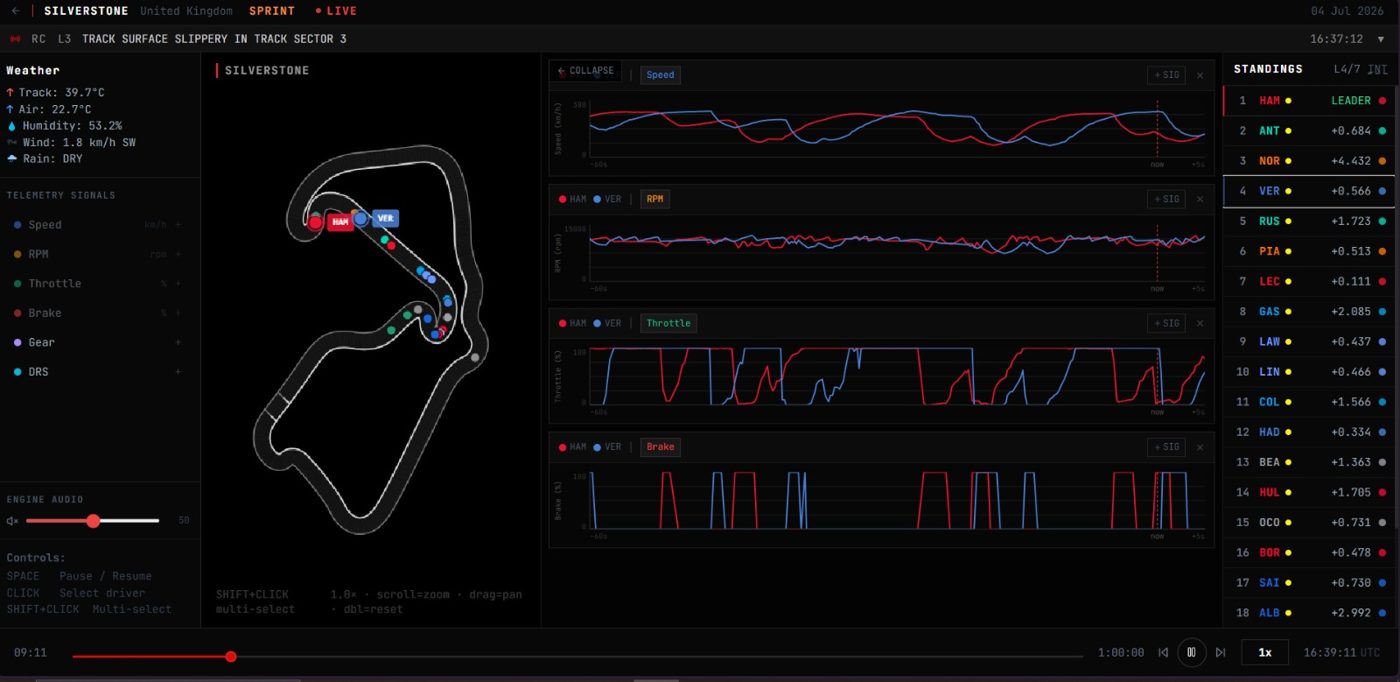
The VinciStack F1 tracker: live positions on-circuit, synchronised speed / RPM / throttle / brake traces, weather, and standings — all rebuilt from a public data feed. Even this is only a sliver of what a real pit wall sees.
But here's the honest, and frankly the more interesting, part. What comes through a public API is a trickle next to what a real team gets at the pit wall. OpenF1 exposes a handful of car channels — speed, throttle, brake, RPM, gear, DRS — at a sampling rate of about 3.7 Hz. That's roughly one reading every 260 milliseconds. Position updates arrive about every four seconds. It's genuinely great data for fans and builders, and it's enough to feel the shape of a race. But hold it up against reality:
| Metric | Through the OpenF1 API | At the actual pit wall |
|---|---|---|
| Sampling rate | ~3.7 Hz — one reading every ~260 ms | up to ~1,000 Hz — hundreds of readings per second |
| Channels exposed | ~6 — speed, throttle, brake, RPM, gear, DRS | 300+ — temperatures, pressures, strain, aero, biometrics |
| Position updates | every ~4 s | ~2 ms car-to-garage latency, continuous |
| Data character | public feed — delayed, down-sampled, unsynced | ~30 MB/lap — full-resolution, context-bound, redundant |
The public feed is down-sampled by orders of magnitude, delayed, and stripped of context. The two location and car-data streams aren't even synchronised with each other. You are looking at a photograph of a photograph of what the team sees. And yet — even that thin slice is enough to build a compelling live picture of a race.
Which is the whole point we want the tracker to make. If a fraction of the data, arriving slowly and stripped of context, can still tell a story this rich — imagine what the full-resolution, context-bound stream does in the hands of a team with the infrastructure to use it. That delta, between the trickle you can see and the flood they act on, is precisely the value of a system that captures, contextualises, and closes the loop on all of it.
The tracker is a demo of the gap, not the solution. It shows you how much signal survives even a thin public feed — and by implication, how much is being left on the table when real engineering data lands in a folder and dies there. VinciStack is what you build when you decide to stop leaving it on the table.
Live now
See a race the way the data sees it
Real-time Formula 1 telemetry and timing, plus replayable past sessions — streamed live through OpenF1. Built by our team as a working demonstration of live data at speed.
Open the F1 Tracker →04 / The point
You don't need an F1 budget. You need the thread.
Here's what we believe, and what the pit wall proves every Sunday: the teams that win aren't the ones with the most data. They're the ones whose data stays connected — from the requirement that motivated a test, to the run that produced it, to the anomaly someone flagged, to the decision that followed, to the next design that got smarter because of it.
Formula 1 spends hundreds of millions to make that loop instant. Most hardware teams — students, startups, even large OEMs — are running the same loop with the thread cut at every handoff, starting each iteration from near zero. That's not a data-collection problem. It's a data-context problem, and it's solvable without a nine-figure budget.
That's the entire reason VinciStack exists: to give every hardware team the streamlined, unified validation pipeline that F1 treats as non-negotiable — so you can iterate faster, and let every run feed the intelligence that accelerates the next one.
Iterate harder, and you're just running the same race with the thread cut. Close the thread, and every lap makes you faster.
ReferencesSources & notes4 sources
Figures in this article are compiled from public sources and are approximate — F1 telemetry specifications vary by season and are not fully published by teams or the FIA.